Written by: Nohea Stevens
He aliʻi ka ʻāina; he kauwa ke kanaka. The land is chief; the people are its servants.
Fifty years ago, in 1976, a small group of people in Waiʻanae Valley began a journey of returning to the ʻāina. They cleared the overgrown loʻi, restored the water and planted kalo again. Today, as Kaʻala Farm celebrates half a century, one truth stands above all others: we did not get here alone. We survived for 50 years because of the kōkua and aloha of so many people who believed in this place and this work.
To those who were here from the beginning
Mahalo to the founders and first families who stood in the valley in 1976 and saw what this place could be again. Mahalo to the young people of the Rap Center who cleared the brush and uncovered the old loʻi walls, and to the community members who helped lay the first pipe in 1978 to bring the water home. Mahalo, too, to the taro farmers of Waiāhole and Waikāne who came across the island to share their knowledge and plant kalo beside us. You started something that is still growing.
To past staff and board members
Mahalo to everyone who has worked at Kaʻala over the past five decades and to every board member who has served before today. You built the hale, rebuilt the road after the rains, fought the fires, wrote the grants and taught the keiki. Some of you gave a season and some gave a lifetime. Your fingerprints are on every loʻi and every path, and this anniversary belongs to you as much as anyone.
To our Waiʻanae community
Mahalo to the people of Waiʻanae, our kūpuna, families, keiki and neighbors. You have trusted us with your children, shared your moʻolelo, defended this valley and its water and stood with us in hard times. Kaʻala Farm grew from this community and exists for it. Mahalo for making this place your own.
To our staff
Mahalo to our Kaʻala ʻohana, the people who show up every day in the sun, the rain and the mud. You open the gates for school groups, care for the loʻi and the māla, fix what breaks, keep the books and welcome every visitor as family. Many of you have given far more than any job description asks. Your dedication is the heartbeat of this farm, and we see you.
To Eric
Mahalo nui loa to Eric Enos, our co-founder and executive director. For five decades, Eric has carried the vision of Kaʻala with humility and quiet strength. He has taught generations of keiki to put their hands in the soil and to know who they are through the ʻāina. Through droughts, fires and lean years, his leadership has kept us rooted and moving forward. So much of what Kaʻala is today grew from the seeds he planted.
To our Board of Directors
Mahalo to our Board of Directors, who serve without pay and carry the kuleana of guiding Kaʻala Farm with care. You give your time, wisdom and steady hands to the hard decisions that keep this place strong, from protecting our finances to planning for the generations to come. Your service holds Kaʻala in trust for our community, and we are deeply grateful.
To our partners, volunteers and funders
Mahalo to our partners, from schools and community groups to agencies and fellow ʻāina-based organizations, who walk alongside us. Mahalo to our volunteers, the thousands of hands that have weeded, planted, harvested and rebuilt over the years, sometimes on a single Saturday and sometimes for decades.
And mahalo to the funders whose generosity sustains this work, including Kamehameha Schools, Hawaiʻi Community Foundation, Hauʻoli Mau Loa Foundation, Hawaiʻi Wildfire Management Organization, Campbell Family Foundation, Hawaiian Electric, The Trust for Public Land and the many individual donors who give what they can. Your support is an investment in Waiʻanae's keiki, our culture and our future.
Looking ahead
As we step into our next 50 years, we carry forward the lessons of those who came before us: care for the land, and it will care for you. Kaʻala Farm belongs to all who have given of themselves to it. We are grateful for every one of you, and we invite you to keep walking this path with us.
May this Thanksgiving season be blessed for you and your ʻohana. With continued mahalo nui loa for all you have given and all you continue to give.
Me ke aloha pumehana,
Kaʻala Farm, Inc.
What's New in the 2026 Hawaiʻi Quality of Life Survey
Georgette Nohea Stevens
Hawaiʻi residents are happier and healthier than they were two years ago, and for the first time the statewide survey asks how culture and the health of our ʻāina and kai shape that well-being.
On Oct. 12, the University of Hawaiʻi at Mānoa's Health Policy Initiative and the Governor's Office of Wellness and Resilience released the 2026 Hawaiʻi Quality of Life and Well-Being Dashboard. More than 10,000 residents took part between February and May 2026, close to 30% more than in 2024. That makes it the largest data set on health and well-being in the state.
The 2026 survey builds on the 2024 baseline, so we can now see not just where Hawaiʻi stands but which way it is heading. It also adds new and expanded measures of the everyday experiences that influence well-being here.
New this year: culture and connection to ʻāina and kai
The 2026 survey looks at how taking part in cultural activities, and the health of our natural environment, relate to well-being. The results are on page 38 of the dashboard.
These measures put numbers to something many in Hawaiʻi already know: our well-being is tied to the land and ocean that sustain us. Aloha ʻāina, love of the land, is a relationship of care. When streams run, loʻi are planted and reefs are healthy, communities have places to gather, learn and feed one another.
The broader findings point the same way. Residents reported stronger support from family, friends and community, and a greater sense of safety and belonging where they live. Researchers say those connections help explain why life satisfaction rose even as financial pressures persisted.
Community spotlight: Kaʻala Farm, Waiʻanae
For nearly 50 years, Kaʻala Farm has shown what the survey is now measuring: restoring ʻāina restores people.
In 1976, Eric Enos was working with Waiʻanae and Nānākuli youth at the Rap Center when they found ancient loʻi terraces buried under brush in upper Waiʻanae Valley. Plantation-era diversions had left the valley, once the poi bowl of the Leeward coast, dry. In 1978, Enos and community members laid a pipe to bring water back to the loʻi, and it has flowed ever since.
Today the Cultural Learning Center at Kaʻala cares for about 100 acres in the shadow of Mauna Kaʻala. Its work reaches well beyond kalo:
Education: the farm has hosted about 3,000 students a year in sustainability learning visits (Star-Advertiser).
Second chances: Papa Hana 'O Kaiona program brings students who are behind on credits to the farm weekly to earn them through hands-on work.
Watershed care: returning water to loʻi and native forest recharges streams, and the farm partners on forest restoration with the Waiʻanae Mountains Watershed Partnership.
As Enos's son Kamuela has put it, the goal was never just to grow food, but to regrow people and community. That is the link between culture, ʻāina and well-being that the 2026 survey sets out to measure.
What else the 2026 survey found
Most measures improved since 2024, but gains are uneven by age, income and county.
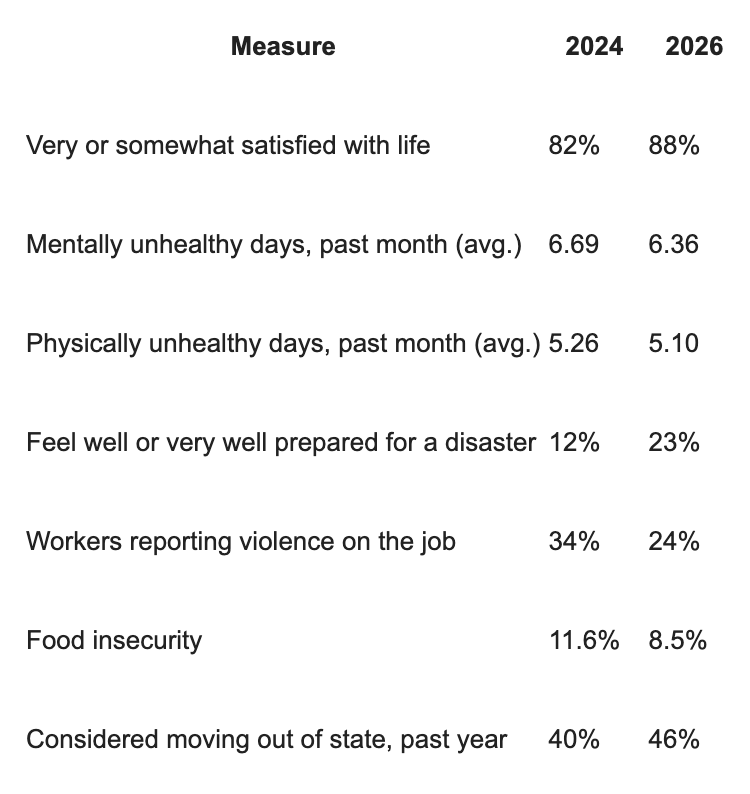
Where the gaps remain:
Young adults carry the heaviest load. Residents 18–24 and 25–34 report 8.5 and 8.9 mentally unhealthy days a month, versus about five or fewer for those 65 and older.
Cost of living drives people away. 37% cited it as a reason to consider leaving; among households earning $25,000–$49,000, 52% considered moving.
Hunger persists at the lowest incomes. Food insecurity is still 27% for households earning under $25,000.
Care is harder to reach on neighbor islands. Too few nearby doctors is a major problem for 21% statewide, from 14% in Honolulu County to 39% in Hawaiʻi County.
Sources